The Jay-Z Ownership Blueprint: From Cultural Influence to Investment Infrastructure
By the BlackRefer Editorial Team · November 20, 2026 · About a 12-minute read
Jay-Z draws the attention. The useful lesson is what sits behind the name: investment institutions, documented rights, and the machinery that turns cultural demand into recurring business income.
The headline is easy to remember: a music company backed by Jay-Z's Roc Nation has secured $665 million to invest in independent music catalogs.
The business underneath that headline is more interesting than the celebrity association. Who raised the money? What kind of money is it? What are they buying? And what does an artist give up when future royalties become cash today?
On November 17, 2026, Duetti announced a financing package comprising a $450 million asset-backed securitization, $165 million in additional credit capacity, and a $50 million side facility. These are the company's announced financing arrangements—not a personal check from Jay-Z, not a purchase of his catalog, and not one newly acquired collection of songs. 1
Duetti lists Roc Nation among its backers. That connection is real. But it does not make Duetti the same company as MarcyPen Capital Partners, the investment platform formed from Marcy Venture Partners and Pendulum Opportunities. They are distinct businesses with different transactions. 2 3
For Black entrepreneurs, the deeper question is not how to imitate a celebrity's portfolio. It is how to build a business that keeps some of the value its work creates—and how to recognize the tradeoffs when that value is sold, licensed, financed, or shared.
Attention can introduce the opportunity. Rights, records, relationships, and execution determine what the business gets to keep.
1. Start by separating the deals
In December 2024, TechCrunch reported that Marcy Venture Partners had merged with Pendulum Opportunities, the investment arm of Pendulum Holdings, to form MarcyPen Capital Partners. A MarcyPen spokesperson confirmed the merger. The report said records indicated it had been finalized around September 2024. 3
Marcy Venture Partners was founded in 2018 by Jay-Z, Jay Brown, and Larry Marcus. Pendulum Holdings was founded in 2019 by Robbie Robinson and D'Rita Robinson. This is not a story of one famous person doing everything alone. It is a combination of investment organizations and the people who built them. 3
TechCrunch reported $900 million in assets under management, citing PitchBook. That is a dated reported figure, not a verified measurement of MarcyPen's assets today. It is also not the price of the merger, the firm's revenue, its profit, or Jay-Z's personal wealth. 3
Assets under management describe assets managed by a firm. They do not automatically belong to the firm's founders. A fund manager can oversee capital supplied by other investors. The economics of the management company, the funds, and an individual partner's interests are separate questions.
The same 2024 report described an effort to raise a $250 million fund under the MarcyPen Opportunities Fund II name. A fundraising target is not proof that the full amount was raised. We should not turn that historical report into a claim that the fund is currently open, fully subscribed, or available to BlackRefer readers. 3
The November 2026 Duetti announcement is a different development: financing for a company that buys, manages, and markets music rights. It does not announce a MarcyPen catalog acquisition. 1
The distinction matters because misleading numbers can make ordinary business strategy seem impossible. A founder hears "billion-dollar empire" and assumes ownership begins with enormous wealth. Often, the transferable lesson begins much earlier: build something identifiable, document who owns it, understand how it earns, and choose partners who can add capabilities you do not have.
2. What MarcyPen illustrates: culture can inform investment, but cannot replace diligence
MarcyPen describes itself as a global investment platform supplying strategic capital to growth-stage consumer businesses that "create, move, and lead culture." That is its stated positioning, not an independently proven investment advantage. 4
The strategic idea is nevertheless useful. Cultural familiarity can help someone notice demand before it appears obvious in a conventional business presentation. It can reveal why a product resonates, which communities are underserved, or when a brand's promise does not match the customer experience.
But knowing what people like is not the same as knowing whether a company makes money. A consumer brand still needs viable margins, dependable suppliers, working capital, repeat purchases, and a reason for customers to stay when the launch excitement fades.
TechCrunch's merger report identified businesses backed by the predecessor firms, including Partake Foods, Spatial Labs, Savage X Fenty, Greenwood, and Adwoa Beauty. That historical portfolio reporting does not disclose the current ownership percentage, investment return, governance rights, or financial condition of any of those businesses. 3
We therefore cannot reconstruct MarcyPen's private cap table from the celebrity connection. Nor should we claim the merger guarantees more funding for every Black founder. A Black-led institution can be significant without being a public grant program or an automatic funding route.
For a small business, the practical version of the cultural thesis is modest: What do you understand about a customer that your competitors miss—and can you turn that understanding into an offer with sustainable economics?
A neighborhood food brand might understand a flavor preference that a national company overlooks. A production studio might understand how a community wants its story told. An educator might understand why existing training is inaccessible. None of these insights is an asset by itself. The business must translate the insight into a product, service, process, or right that it can deliver and protect.
3. What Duetti illustrates: institutions are financing the income behind the music
Duetti's November 17 announcement says it has completed more than 1,600 catalog investments since its establishment in 2022. It reports a catalog spanning more than 50,000 masters and compositions, representing more than 3,000 recording artists. These are company-reported scale figures, not independently audited totals presented by BlackRefer. 1
Its own description says it provides capital and operational support to artists, songwriters, and producers to monetize, manage, and grow their catalogs. Its backing includes Roc Nation alongside other investors. This is a business built around many rights owners—not evidence that Jay-Z owns every catalog it acquires. 2
The financing announcement also describes investments in technology, data infrastructure, royalty optimization, catalog management, and marketing programs. That operational layer matters. Buying rights is only one part of the model; collecting, administering, and developing the income associated with those rights is another. 1
An asset-backed securitization raises financing through securities supported by assets and associated cash flows. In this case, the announced transaction is connected to music catalog income. It is not the same thing as selling new equity in Duetti, and it is not proof that royalties are risk-free or guaranteed to grow.
Credit capacity is also not identical to cash already paid to artists. A financing facility can support future transactions under its terms. The press release does not disclose every borrowing condition, acquisition price, artist contract, or allocation of risk. We should not fill those gaps with a success story that the evidence cannot support.
For an entrepreneur, the insight is broader than music: a documented stream of income can attract partners in ways that a promising audience alone may not.
That does not mean every small business can borrow against its future revenue, or that it should. It means clean records and durable contracts change the quality of the conversation. A buyer or financier needs to understand what exists, what generates the income, who owns it, and what could interrupt it.
4. A song is not one undivided piece of property
The U.S. Copyright Office distinguishes a musical composition from a sound recording. The composition includes the music and any accompanying lyrics; a sound recording captures a particular performance. They are separate works and can have different owners. 5
This distinction is easy to miss in headlines about "buying a catalog." A transaction may involve compositions, recordings, specified royalty interests, or a defined share of particular rights. Buying one interest does not necessarily transfer every right connected to the song.
An artist's name and image are another set of issues. Ownership of a recording does not automatically mean unlimited permission to use an artist's likeness in advertising. Likewise, possession of the audio file is not proof of copyright ownership.
Before discussing a sale, license, or financing arrangement, the owner needs a rights map. Which works are included? Who are the collaborators? What agreements already exist? What portion of the income belongs to someone else? Are any interests pledged, restricted, disputed, or subject to approval?
The same discipline applies outside music. A filmmaker needs to know whether footage, music, and contributor permissions permit a new use. A designer needs to know what the client contract transferred. An educator needs to distinguish their original teaching materials from third-party material they have permission to use only in a particular setting.
Creating the work, holding a copy, and owning the transferable rights are not always the same thing. The Copyright Office's work-made-for-hire guidance explains circumstances in which an employer or commissioning party is treated as the author. Contract language and the specific facts require qualified legal review. 6
The first ownership upgrade may not be a new company. It may be finding the signed agreements for the work the business already makes.
5. Selling future income can be sensible—and still deserve scrutiny
A catalog sale is not automatically a betrayal of ownership. Cash today can fund a new project, reduce financial pressure, support a business expansion, or diversify an owner's exposure to one source of income.
Keeping every right is not automatically the best outcome either. An owner may lack the resources to administer or develop the work effectively. A capable partner can contribute capital, specialist expertise, or operational support. The important question is what the contract actually exchanges.
The tradeoff is that future upside, control, or income may be reduced. The right decision depends on the particular rights, price, duration, obligations, alternatives, and the owner's circumstances—not the fame of an investor associated with the buyer.
Consider a deliberately simplified illustration. A creator receives $20,000 a year from a specified royalty interest and is offered $80,000 to sell that interest outright. Dividing $80,000 by $20,000 produces four years of the current annual receipts.
That calculation is only a starting comparison. It is not a valuation, a fair-price estimate, or a recommendation to accept or reject. It ignores changes in demand, collection costs, taxes, timing, discount rates, contract restrictions, and the possibility that future receipts rise, fall, or stop. The offer may involve a different scope than the owner initially assumes.
Questions that matter more than the headline multiple include:
- Exactly which rights and works leave my control?
- Is the transfer permanent, time-limited, or restricted to a particular income stream?
- What do I retain, and can I still license or use the work elsewhere?
- Who bears expenses, and which deductions happen before I am paid?
- What records and reporting rights will I receive?
- Are there approval rights, warranties, repayment obligations, or indemnities?
- What is my realistic alternative if I decline?
- What will the cash allow me to do that I cannot otherwise do responsibly?
Get independent advice from professionals who are not paid to close the buyer's transaction. A recognizable backer may be relevant context. It is not a substitute for understanding your own agreement.
6. The small-business blueprint: build the institution before chasing the headline
Most Black entrepreneurs will not build an investment platform or securitize a music catalog. The ownership lesson does not require either.
First, identify the repeatable value. What does your business produce that people will pay for more than once? This could be a service process, an original catalog of work, a product customers reorder, or a licensed educational resource. Repeatability is not the same as passive income; maintenance and delivery still cost money.
Second, document the asset. Put the rights, agreements, financial records, and operating responsibilities in a usable file. A prospective partner should not have to guess who owns the work or which payments belong to the business. Protect sensitive information and share it only when appropriate.
Third, separate attention from economics. A large following may help with discovery. It does not disclose delivery costs, customer retention, debt, or profit. Track the economics of one offer before expanding into another. An enthusiastic launch can conceal a business that is expensive to run.
Fourth, choose the missing capability—not just the most impressive name. A partner might contribute distribution, administration, manufacturing, marketing, or financial expertise. Write down the problem the partnership solves and what your business gives in return.
Finally, preserve room to decide. Avoid treating every offer as a once-in-a-lifetime opportunity. Keep organized records, understand your cash needs, and compare alternatives before urgency makes the choice for you.
This is the institutional lesson behind the celebrity signal. People build enduring businesses by making value legible, assigning responsibilities, and managing tradeoffs. Cultural recognition may open a door. The operating system determines what happens after the introduction.
7. A 30-day ownership action plan
Days 1–7: inventory. List the work, products, contracts, and recurring relationships that currently earn money. Separate what the business clearly owns from what needs review. Choose one revenue-producing asset or offer to examine first.
Days 8–14: reconcile. Match receipts to statements, invoices, and agreements. Identify collaborators, deductions, missing documents, and any concentration in one customer or platform. Do not assume the amount arriving in your account tells the whole economic story.
Days 15–21: assess the constraint. Is the business short of cash, administration, distribution, capacity, or customer demand? These are different problems. Selling an asset will not automatically solve a weak product or an unreliable delivery process.
Days 22–30: choose one next step. It might be a contract review, a bookkeeping cleanup, a limited licensing discussion, a small product test, or a decision to retain the asset and improve its administration. Name the responsible person and set a review date.
If you need accountants, attorneys, production teams, designers, or other business services, use the BlackRefer Directory as a discovery starting point. Check the actual listing and independently assess qualifications, experience, pricing, availability, and fit. Directory inclusion is not a guarantee or an endorsement of a proposed transaction.
For the creator-business foundation, read The Creator Cap Table. For offer economics, read Pricing for Profit, Not Apology. For broader capital decisions, read When the Bank Isn't the First Call.
The point is not that every business should become Jay-Z's business. It is that the attention your work creates should lead you toward a clearer answer to a practical question: What are you building that your business can actually keep?
Ownership Infrastructure Brief — printable worksheet
Business / creator: ____________________________
Decision owner / review date: ____________________________
- Asset or repeatable offer to review: ____________________________
- Rights or ownership confirmed by which documents? ____________________________
- Collaborators, restrictions, or unresolved obligations: ____________________________
- Review period, receipts, deductions, and supporting records: ____________________________
- Largest customer, platform, or payer—and interruption risk: ____________________________
- Missing capability a partner would supply: ____________________________
- Rights, money, or control requested in exchange: ____________________________
- Alternative to the deal, independent reviewer, and next action: ____________________________
This is a planning brief, not a valuation or investment assessment. Do not include sensitive account, customer, or contract information in public copies.
Sources
Source 1
Duetti — $665M in New Funding to Accelerate Investment into Independent Music Catalogs. November 17, 2026. Company-issued announcement: financing components, reported catalog scale, and operational programs. Not an independent financial audit or disclosure of all transaction terms.
Source 2
Duetti — About. Reviewed November 20, 2026. First-party description of its model, founders, and backing, including Roc Nation. Investor presence does not establish Jay-Z's personal investment amount or ownership percentage.
Source 3
TechCrunch — Jay-Z's Marcy Venture Partners Merges with Investment Arm of Pendulum Holdings. December 16, 2024. Spokesperson-confirmed merger; historically reported AUM and fundraising figures attributed to the report's sources. Not current AUM or a disclosed private cap table.
Source 4
MarcyPen — Official Site. Reviewed November 20, 2026. Firm's stated investment positioning. No performance or return claims inferred.
Source 5
U.S. Copyright Office — Circular 56A: Copyright Registration of Musical Compositions and Sound Recordings. Reviewed November 20, 2026. Official distinction between compositions and sound recordings; individual ownership and licensing require review of the actual agreements.
Source 6
U.S. Copyright Office — Circular 30: Works Made for Hire. Reviewed November 20, 2026. Official explanation of qualifying work-made-for-hire arrangements; not a determination of any reader's rights.
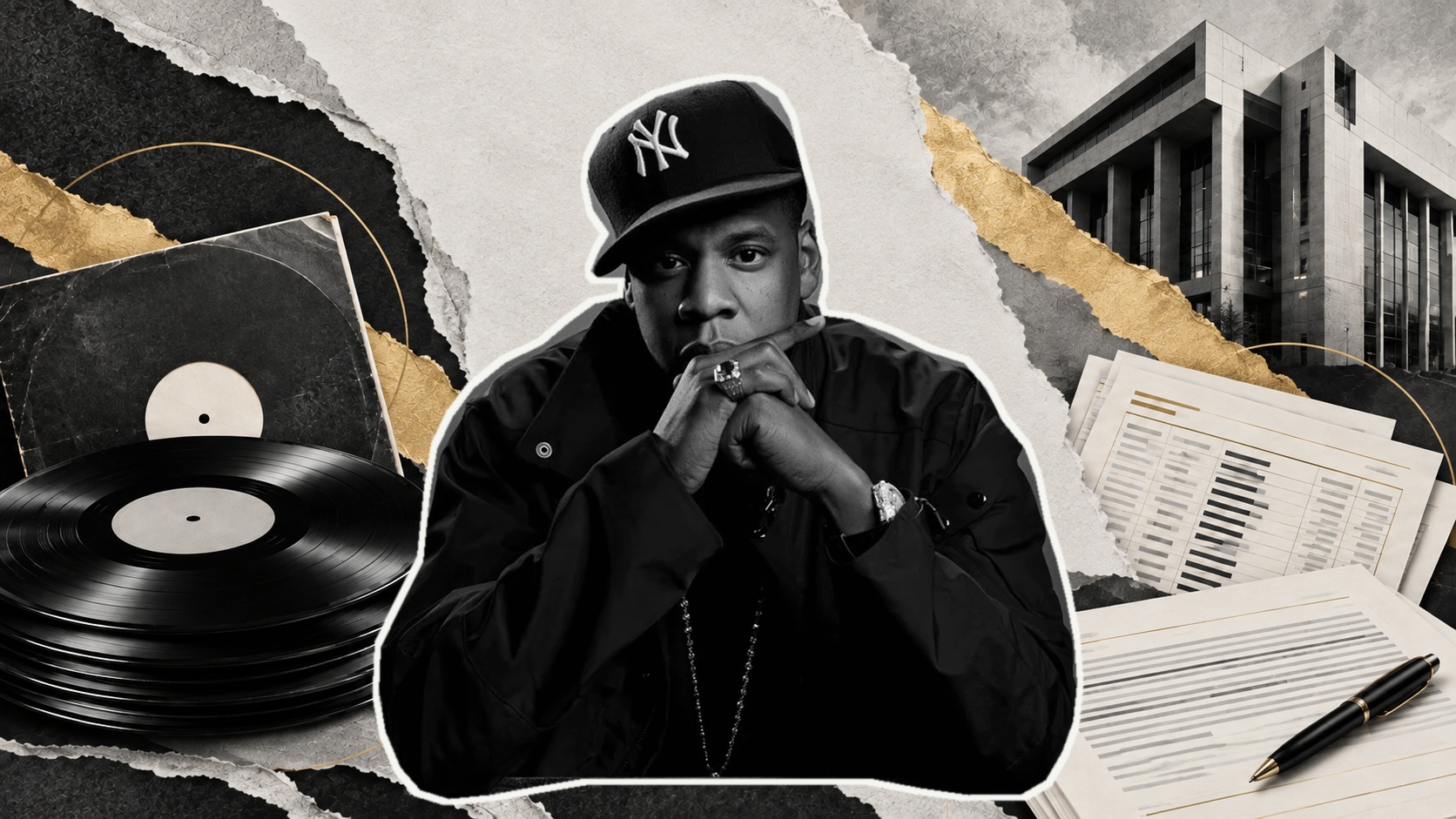
Cover credit: Jay-Z photograph supplied by BlackRefer with publication permission confirmed. Background removed, converted to monochrome, and combined with an AI-generated editorial music-rights collage. Portrait, not a photograph of the reported transactions; no endorsement implied.
Editorial note: Business frameworks, the 30-day plan, and the royalty comparison are hypothetical or BlackRefer editorial analysis. Company examples are not endorsements, investment offers, or verified performance claims. This briefing does not disclose private ownership percentages or establish that every named company is Black-owned. General business education only; not legal, tax, financial, or investment advice.
The BlackRefer Briefing
Market intelligence, venture capital insights, emerging trends, and leading Black-owned businesses—all delivered to your inbox.