Culture as Competitive Advantage, Not Decoration
By Askia Jones · November 6, 2026 · About a 10-minute read
How Black-owned brands can turn heritage, identity and cultural knowledge into a real strategic asset, in product, trust and storytelling, instead of a pattern on the packaging or a post in February.
Every February, the same things show up: a kente-print border on a product page, a “for the culture” slogan, a campaign that disappears in March. None of it is wrong, exactly. It just doesn’t do much, and customers can tell when culture is a costume.
For a Black-owned business, culture can be much more than that. It can be the reason you saw a need others missed, the reason customers trust you before they’ve tried you, and the reason your story is worth repeating. That’s a competitive advantage, but only when it shows up in the product, the decisions and the details, not just the design.
The market is real. The U.S. Census Bureau counted about 201,000 Black-owned employer businesses with $249.0 billion in receipts in 2023, plus 4.4 million Black-owned businesses without employees. 1 NielsenIQ puts Black buying power at roughly $2 trillion. 2 But size alone doesn’t make an advantage. Depth does.
Below: why specificity wins, how culture becomes product insight, where tokenism and appropriation trip brands up, what changes when a brand scales or sells, and a self-audit you can run this week.
Why specificity beats generic identity marketing
“Black consumers” is not one customer. NielsenIQ’s 2026 report calls Black consumers “far from monolithic” and notes that about 20% of Black people in the U.S. are immigrants or the children of immigrants, 8% trace their heritage to the Caribbean and 9% speak a language other than English at home. 2 A Nigerian-American family in Houston, a Haitian community in Miami and a fourth-generation family in Detroit may share a lot. They don’t share everything.
Generic identity marketing ignores those differences. Specific marketing names them. Nielsen’s January 2026 report on Black audiences found that 67% of Black audiences surveyed pay more attention to ads in media that reflect their culture, 71% of Black consumers feel misrepresented in the media and 70% will stop buying from brands perceived as devaluing their community. 3 Nielsen’s own summary: what earns attention and loyalty is “inclusion of experiences that move beyond tokenism to embrace authenticity.” 3
Specificity is also harder to copy. Anyone can buy a stock image of patterned fabric. Not everyone knows what a 4c curl needs after wash day or which spices a family recipe actually calls for. That knowledge is the asset.
Culture as product insight
The strongest culturally rooted brands start with a problem the founder lived and the mainstream market ignored.
McKinsey’s 2021 analysis found that Black consumers were far more likely than White consumers to say current offerings don’t meet their needs, especially in personal care, banking, healthcare and food. It estimated Black consumers would shift about $260 billion of spending to companies that serve them better, part of what it called a $300 billion opportunity. 4
Bevel. Tristan Walker founded Walker & Company in 2013. Its men’s line, Bevel, was designed to reduce razor bumps and irritation for men with coarse or curly hair. Walker told CNN Business he was frustrated by “that second-class citizen experience of having to shop in an ‘ethnic’ beauty aisle.” 5 The insight wasn’t “Black men shave.” It was a specific skin problem the leading razors weren’t built to solve.
Pattern Beauty. When Tracee Ellis Ross launched Pattern in 2019, it was built for what WWD called the “underserved curly, coily and tight-textured community.” Ross told WWD she first pitched the idea in 2008, and that the line was tested by a panel of women with 3b to 4c hair textures. Products came in larger size-to-price ratios to meet the community’s need for more product. “Most of us in this community have had to become our own experts,” she said. 6 Every detail in that launch came from knowing the customer.
Fenty Beauty. Rihanna launched Fenty Beauty in September 2017 with 40 shades of foundation; the launch release said the line was built for “traditionally hard-to-match skin tones.” 7 Within days, CNN reported that eight of the 10 deep foundation shades had sold out on Sephora’s website. 8 The demand had been there all along. Most brands just hadn’t made the product.
Partake Foods. Culture isn’t only heritage; it’s also lived experience. Denise Woodard has written that she started Partake after her young daughter was diagnosed with multiple food allergies and she couldn’t find a snack that was safe, nutritious and appealing. Her rule: the cookie “had to be good enough that a kid without any allergies would choose it first.” 9
The lesson for a small business: write down the three things your customers complain about that big brands never fix. That list is your product roadmap.
Authenticity and trust
Authenticity isn’t a tone of voice. It’s whether your decisions match what you say. Customers who have been ignored or misread by big brands watch closely for the moment you stop seeing them.
In April 2017, SheaMoisture, a brand known for serving Black women, released a 60-second ad in its #EverybodyGetsLove campaign about “hair hate.” As NBC News reported, many viewers noticed that only one of the women featured was Black. After a fast backlash, the brand pulled the ad and posted a blunt apology. Founder Richelieu Dennis named the real fear behind the reaction: “Women are concerned that as Shea Moisture grows, they want to make sure that we are not abandoning them or leaving them for a larger audience.” 10 A company spokesperson said the ad was one segment of a larger campaign and that its execution “was flawed.” 11
The ad broke trust because it suggested the brand’s core customers were being moved to the back.
Trust is built in ordinary places: how you treat staff, whether the formula changes quietly, whether community programs outlast the press release. Nielsen found that 57% of Black consumers say they’ll stop using a company that mistreats its employees. 3
Tell your origin story without performing it
Your story matters, but it isn’t a performance. A useful origin story does three things:
- Names the problem plainly. What did you need that you couldn’t find?
- Shows the work. Pattern’s launch story included the 2008 pitch and the testing panel. 6 Specifics are believable. “We’re passionate about our community” isn’t.
- Connects to the product. Woodard tells hard parts of Partake’s story, including draining her 401(k), but ties them to decisions, like refusing to compromise on taste. 9
What to avoid: trauma as a sales tool, struggle you didn’t live and history you haven’t checked. If your grandmother’s recipe is the story, tell it with her name and her town. If your story is ordinary, tell it anyway. “I was a nurse who couldn’t find scrubs that fit” beats an invented legend.
Avoid tokenism and appropriation
Black-owned brands aren’t immune to tokenism or appropriation. Both happen when culture is used as a look, without the people and meaning behind it.
Telfar Clemens put the tokenism trap bluntly in a 2020 email interview with Hypebeast: “We are not ‘inclusive’ — we are Black-owned and non-gendered since 2004. We went from marginalized to tokenized quick.” 12 The brand’s answer, he said, was to build “within our own community — from customers to collaborators.” 12
Respect cultural sources. If you use a textile, symbol or pattern from a specific culture, know where it comes from and what it means. Buy from or partner with makers from that tradition when you can, and say so on the label. African and diaspora cultures are many cultures, not one aesthetic.
Credit and pay creators. That includes the illustrator, the photographer, the muralist, the designer of the pattern and the musician in your video.
License what you use. The U.S. Copyright Office says the way to use someone else’s work is to ask permission. Fair use can sometimes allow a quote or sample without permission, but it depends on all the circumstances, and in cases of doubt the Office recommends getting permission. 13 Music is especially easy to get wrong: a song and a recording of it are two separate copyrights. The Copyright Office’s own example is that the composition “Respect” and a recording of Aretha Franklin singing “Respect” are two distinct works. 14 Using a track in an ad generally means clearing both, not just one.
Get commissioned work in writing. If you hire a freelance artist for a logo, pattern or mascot, don’t assume you own it. Under copyright law, a commissioned work counts as “made for hire” only if it falls within one of nine specific categories and there’s a written agreement; otherwise the author is ordinarily the person who created it. 15 Ask a lawyer about a written assignment or license, and credit the artist where it’s fair to do so.
Protect what you create
Culture-rich brands are often copied: the name, the slogan, the signature pattern, the product shape. Protect them early. Your business name and slogan may be trademarks; original artwork, packaging copy and photography may be protected by copyright. Our earlier Insight, Own Your Name Before Someone Else Does, walks through trademark searches, costs and filing. If a conflict forces a name change, When to Rebrand, and When You Just Need to Clean Up covers how to switch without losing customers.
Design for the culture, stay open to everyone
Rooting a brand in Black culture doesn’t mean closing the door. The best examples do both.
Telfar’s motto is “not for you, for everyone.” CNN notes that the Shopping Bag’s universal appeal is by design: it’s carried by Beyoncé and by office workers, and even the most expensive versions often cost less than $300. 16 Clemens told Harper’s Bazaar he set the price in line with what he used to take home from a night of deejaying, and described the appeal this way: “No, the old lady does too, and so does that baby, and so do I.” 17
Fenty Beauty described itself as “created for everyone,” and its launch still made the deepest shades the headline. 8 Partake’s taste rule was designed for children with allergies and for every kid at the party. 9
The pattern: build for the customer the market ignored, with standards so high everyone else wants in. Don’t water down the product to widen the audience.
When the brand scales or sells
Growth tests culture. Retailers, investors and eventually an acquirer will all want the brand to reach more people.
Bevel and P&G. In December 2018, Procter & Gamble acquired Walker & Company. TechCrunch reported the company would operate as a wholly owned subsidiary, with Walker staying on as CEO and the team moving to Atlanta. P&G’s beauty chief cited Walker & Company’s “deep consumer understanding” and “authentic connection to its community.” 18 In other words, the cultural knowledge was part of what P&G was buying. In 2023, Walker stepped down as CEO and moved into an advisory role at P&G. 19
SheaMoisture and Unilever. In November 2017, Unilever announced an agreement to acquire Sundial Brands, SheaMoisture’s parent. 20 The ad controversy seven months earlier showed how closely core customers watch a growing brand. 10
Retail scale. The 15 Percent Pledge, which Brother Vellies founder Aurora James launched on Instagram in 2020, asked major retailers to devote at least 15% of shelf space to Black-owned businesses. Sephora became the first major retailer to sign, at a time when it said only seven of the 290 brands it sold in the U.S. were Black-owned. 21 James told Vogue that the pledge was built for long-term accountability rather than one-time donations. 22
If you plan to scale or sell, decide now what can’t change: core formulas, the founder’s role, sourcing, community commitments. Put the important ones in writing in any deal, knowing that after a sale you may not control them. Tell customers about big changes before they find out on their own.
Depth vs. decoration: a self-audit
| Area | Decoration | Depth |
|---|---|---|
| Product | Same product, culture-themed packaging | Solves a need you know firsthand that others missed |
| Customer | “Black consumers” as one group | A specific customer, community or need you can describe in detail |
| Story | Vague heritage claims, borrowed struggle | Names, places, the problem and the work, all verifiable |
| Visuals | Stock kente, generic “African” prints | Sourced, credited and, where possible, made with artisans from that tradition |
| Music and art | Trending audio, unlicensed images | Licensed tracks and artwork, credited creators, written agreements |
| Calendar | Black History Month campaigns only | Culture shows up all year in the product and the decisions |
| Language | “For the culture” slogans | Words your customers actually use, tested with them |
| Community | One-time donation post | Ongoing programs, local suppliers, staff treated well |
| Inclusion | Narrow by default, or diluted to please everyone | Built for your core customer, open to anyone who values it |
| Protection | Unregistered name, unsigned freelance work | Trademark search and filing, signed assignments or licenses |
| Growth | Core customer quietly sidelined | Non-negotiables written down before scaling or selling |
If most of your answers land in the middle column, you don’t need a new look. You need a deeper strategy.
An illustrative example
Illustrative example. The business, the owner and the product below are fictional, created for this article. Any resemblance to a real business or mark is unintended.
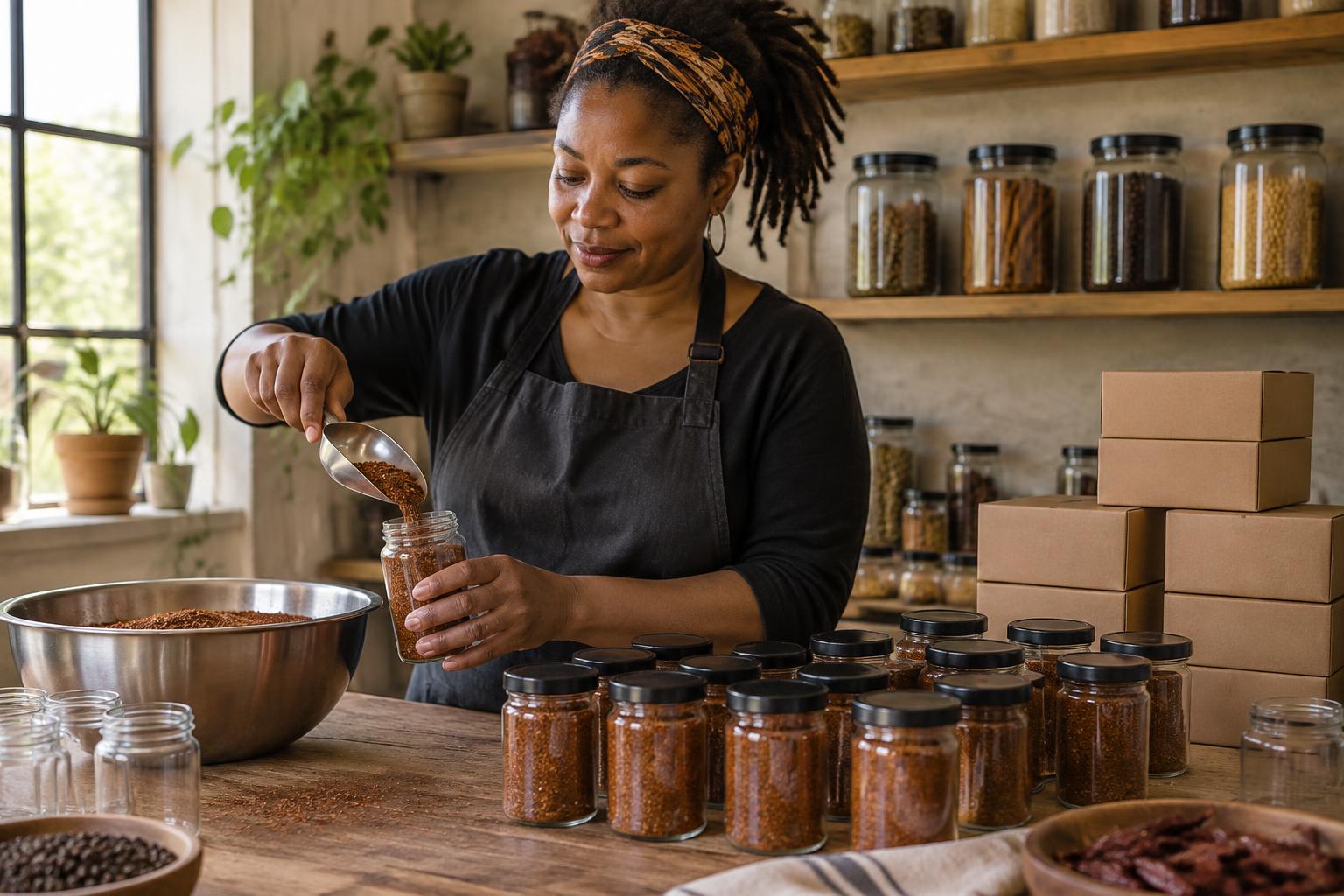
Adaeze runs a small spice company in Atlanta. Her first labels featured a generic “African” print and the tagline “Taste the Motherland.” Sales were flat, and a customer from Ghana politely told her the print wasn’t from Nigeria, where Adaeze’s family is from.
She started over with specifics. She built her lead product around the pepper soup blend her mother makes, named the town her family comes from on the label and explained in plain words how to use it. She hired a Nigerian-American illustrator, signed a written agreement covering ownership of the artwork and credited the illustrator on the box. For her launch video, she licensed a track from an independent Afrobeats producer instead of pulling a popular song. Before printing, she ran a trademark search on the product name.
Her copy now explains what pepper soup is, when her family eats it and why the blend is hard to find in U.S. stores. Some of her best customers have never been to West Africa. They just like the soup.
Culture is the strategy, not the skin
Culture becomes a competitive advantage when it changes what you make, whom you serve, how you treat people and what you refuse to compromise. Start with the problem you know better than anyone, tell the story with real details, credit and pay the people whose work you use, protect what you build and decide early what won’t change when you grow. That kind of culture can’t be printed on a label, and it’s hard to copy.
This article is general information, not legal advice. Copyright, licensing and trademark rules are complex; check with a qualified attorney before you use someone else’s work or sign an agreement.
Follow BlackRefer Insights for more practical, sourced guides for Black business owners. And if you know a Black-owned business that builds with this kind of depth, refer it to the BlackRefer directory.
About the author: Askia Jones is the founder of BlackRefer and the Black Ecosystem, a network of platforms covering Black business, health, scholarship, culture and innovation, including Melanated.ai. He builds and runs these properties with the help of AI tools for research, editing and planning, and he writes Insights to give Black-owned businesses practical guidance they can use right away.
Data, company facts and Copyright Office guidance in this article were current as of November 6, 2026. Check each source for the latest.
Sources
Source 1
U.S. Census Bureau, “Census Bureau Releases New Data About Characteristics of Employer and Nonemployer Business Owners,” press release CB25-TPS.77, November 20, 2025 (2024 Annual Business Survey, reference year 2023, and 2023 Nonemployer Statistics by Demographics). https://www.census.gov/newsroom/press-releases/2025/business-owner-characteristics.html
Source 2
NielsenIQ, “The Power of the Black Dollar: Illuminating the influence, intention, and impact behind the Black dollar,” February 2026 (PDF). https://nielseniq.com/global/en/wp-content/uploads/sites/4/2026/02/NIQ-The-Power-of-the-Black-Consumer-2026.pdf
Source 3
Nielsen, “Nielsen: Two-Thirds of Black Consumers Pay More Attention To Ads That Reflect Their Culture,” press release on “The Black Influence: How Black Culture & Identity Drive the Market,” January 19, 2026. https://www.nielsen.com/news-center/2026/nielsen-two-thirds-of-black-consumers-pay-more-attention-to-ads-that-reflect-their-culture/
Source 4
McKinsey & Company, “A $300 billion opportunity: Serving the emerging Black American consumer,” August 6, 2021. https://www.mckinsey.com/featured-insights/diversity-and-inclusion/a-300-billion-dollar-opportunity-serving-the-emerging-black-american-consumer
Source 5
Nathaniel Meyersohn, “Procter & Gamble builds a strategy to win African-American consumers,” CNN Business, December 12, 2018. https://www.cnn.com/2018/12/12/business/procter-and-gamble-bevel-razors-tristan-walker-walker-and-company
Source 6
Booth Moore, “Tracee Ellis Ross Launches a Hair-care Brand to Empower the Curly, Coily, Textured Community,” WWD, September 3, 2019. https://wwd.com/beauty-industry-news/beauty-features/feature/tracee-ellis-ross-launches-pattern-haircare-brand-1203250156/
Source 7
Kendo/Fenty Beauty, “Rihanna Launches Fenty Beauty, a Global Makeup Brand, in 17 Countries,” press release via PR Newswire, September 7, 2017. https://www.prnewswire.com/news-releases/rihanna-launches-fenty-beauty-a-global-makeup-brand-in-17-countries-300516042.html
Source 8
Melissah Yang, “Rihanna’s new makeup line throws all kinds of shade,” CNN, September 13, 2017. https://www.cnn.com/2017/09/13/entertainment/rihanna-fenty-beauty-foundation
Source 9
Denise Woodard, “Why I Built Partake,” Partake Foods, May 6, 2026. https://partakefoods.com/blogs/all/why-i-built-partake
Source 10
Amber Payne and Chandelis R. Duster, “‘We really f-ed this one up’: Shea Moisture apologizes for ad,” NBC News, April 25, 2017. https://www.nbcnews.com/news/nbcblk/shea-moisture-ad-falls-flat-after-backlash-n750421
Source 11
Diana Bradley, “‘We really f-ed this one up’: Inside Shea Moisture’s response to ‘whitewashing’ accusations,” Campaign US (first published in PR Week), April 26, 2017. https://www.campaignlive.com/article/we-really-f-ed-one-up-inside-shea-moistures-response-whitewashing-accusations/1431669
Source 12
Emily Jensen, “For Telfar, Value Without Scarcity Is the Real Holy Grail,” Hypebeast, August 19, 2020. https://hypebeast.com/2020/8/telfar-bag-security-program-launch-interview
Source 13
U.S. Copyright Office, “Can I Use Someone Else’s Work? Can Someone Else Use Mine?” (FAQ). https://www.copyright.gov/help/faq/faq-fairuse.html
Source 14
U.S. Copyright Office, Circular 56A, “Copyright Registration of Musical Compositions and Sound Recordings” (PDF). https://www.copyright.gov/circs/circ56a.pdf
Source 15
U.S. Copyright Office, Circular 30, “Works Made for Hire” (PDF). https://www.copyright.gov/circs/circ30.pdf
Source 16
Ramishah Maruf and Clare Duffy, “The designer of the ‘Bushwick Birkin’ is rewriting the rules of fashion,” CNN Business, December 4, 2023. https://www.cnn.com/2023/12/04/business/telfar-clemens-risk-taker
Source 17
Alison S. Cohn, “Telfar Clemens Is Rewriting the Rules of Luxury Retail,” Harper’s Bazaar, December 15, 2020. https://www.harpersbazaar.com/fashion/designers/a34965322/telfar-clemens/
Source 18
Anthony Ha, “Procter & Gamble acquires Walker & Company, Tristan Walker will remain as CEO,” TechCrunch, December 12, 2018. https://techcrunch.com/2018/12/12/procter-gamble-acquires-walker-company/
Source 19
BeautyMatter, “July 2023 Beauty Executives on the Move,” August 3, 2023. https://beautymatter.com/articles/beauty-executives-on-the-move-july-2023
Source 20
Cravath, Swaine & Moore LLP, “Unilever’s Acquisition of Sundial Brands,” November 27, 2017. https://www.cravath.com/news-insights/unilever-s-acquisition-of-sundial-brands.html
Source 21
Emily Tannenbaum, “Sephora Is the First Company to Sign ‘15 Percent Pledge’ to Sell More Black-Owned Brands,” Glamour, June 10, 2020. https://www.glamour.com/story/sephora-15-percent-pledge-black-owned-brands
Source 22
Steff Yotka, “Sephora Becomes the First Brand to Take Aurora James’s 15% Pledge,” Vogue, June 10, 2020. https://www.vogue.com/article/sephora-becomes-the-first-brand-to-take-aurora-james-15-pledge